Chemical loading safety is critical in every industrial facility handling flammable liquids. Improper chemical transfer can cause fires, vapor exposure, spills, and serious injuries.
Therefore, the main intent of this document is to create a healthy and safe working atmosphere during –
- Unloading from road tankers to storage vessels.
- Unloading drums/containers.
- Dosing of chemical in to system from Chemical filled drums.
Prefer a quick visual overview? Then, watch the video below for a detailed explanation of Chemical Loading and Unloading Safety, including a complete Tanker and Drum Handling Guide.

INTRODUCTION:
There is a potential hazard involved in handling various chemicals, but it can be minimized by knowing how to handle chemicals properly and then putting this knowledge into practice.
In fact, most of the liquids handled in loading/unloading areas are flammable in nature having low flash points.
There is a possibility of catching fire due to any source of ignition like sparks, high temperature, or static charge etc.
Therefore, Extreme care should be taken for minimizing any chance for the occurrence of fire, inhalation of vapors etc.
SAFETY PREPARATION FOR CHEMICAL LOADING UNLOADING:
- First of all, Confirm to check list for tanker unloading.
- Secondly, available qty of Chemicals in the tanker and available space, which we can unload into.
- Further, Confirm the quality of chemicals for spec.
- Additionally, check tank / vessel LG are OK take off are clear.
- Moreover, tank / vessel drain Block Valves are shut.
- At the same time, overflow line related with elimination water laid up.
- Effluent pit empty / partially empty in case of any spillage.
- Before proceeding, ensure unloading hose healthiness.
- Likewise, pump availability ensured.
SAFETY:
Operator/Technicians engaged in the operation of loading/unloading should know the properties
of chemicals handled in the area.
Most importantly, as far as possible “NO HOT JOBS / NO SPARKING” should be observed.
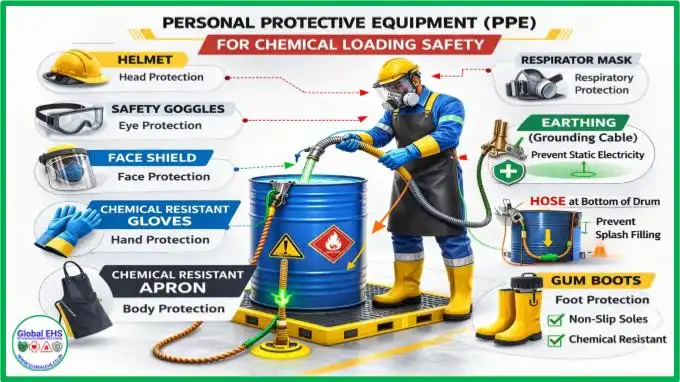
The operator/technician/Contractor, engaged in making connections and all other persons directly connected with loading/unloading work, must therefore wear personal protective equipment including a face shield, goggles, apron, rubber/PVC hand gloves, gum boots etc.
Moreover, tanker / owner / driver must possess the following documents / test certificate of safety valve, if any and pressure gauge: –
- Valid permission of RTO (Vehicle registration and road worthiness).
- Valid driving license
- Valid explosive license from CCE.
- Portable fire extinguisher.
- First-aid box and tools kit in order to attend emergencies.
- Personal protective equipment.
- Certified flame arrestor.
- TERM Card.
- Emergency information panel on two sides and backside of the tanker.
- Training certificate from recognized source.
PROCEDURE:
- To begin with, Position the tanker at the nearest point of loading/unloading facilities.
- Stop engine, provide wheel hoke/stopper at all the four wheels to avoid any movement.
- Then, keep brakes applied on road tanker and keep it in gears (Not in neutral gear).
- Whenever possible, try to avoid loading/unloading after sun set and during storms, lightening etc.
- Furthermore, use always explosion proof lamps/torches for inspection etc.
- Avoid unauthorized and unnecessary entries to the area. Only desired number of persons should remain during operation.
- Everyone must know fire-fighting appliances present in the area and they should know how to use in case of fire.
- Parking of waiting tanker should not obstruct the fire fighting operation in case of emergency.
- Strict prohibition for entering in tanker compartment.
- Ensure closure of tanker O/L valve & de-blind the end flange at tanker O/L valves.
- Tanker vent is open.
- After that, connect unloading hose from tanker to pump suction.
- Keep pump discharge Block Valve closed & crack open tanker O/L valve & carry out leak test if any.
- Meanwhile, keep a running water hose at site.
- Line up tanker O/L Block Valve fully
- Subsequently, check pump discharge line up to vessel I/L lines, on top feed to the vessel.
- Ensure isolation of standby pump & the pump in use, casing drain, shut PG drain valves.
- Proper grounding/bonding to the tanker to be provided before starting transfer for safe discharge of static electricity.
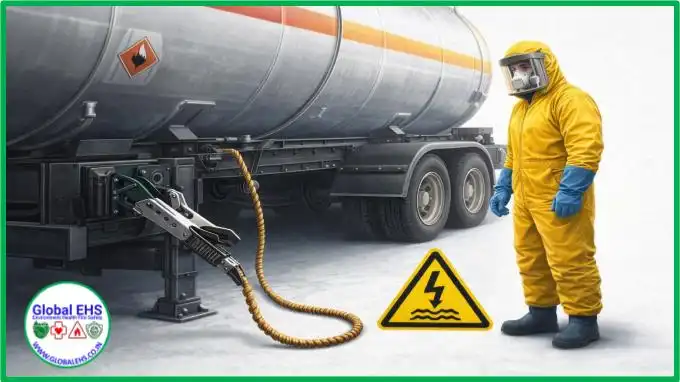
- Then, start the pump (check for direction) & slowly change the d/s line by opening discharge valve.
- Confirm that pump discharge pressure is ok & not hunting.
- Start taking level in the storage tanks.
- Confirm level rise through LG. Stoppage of makeup to storage tank once overflow starts even if LG is not indicting, when LG is malfunctioning.
- After completion, close storage tank I/L B/V, stop pump, close tanker O/L B/V Drain hold up in pump suction hose by opening drain valve.
- Once drainage of hose, disconnect the hose from tanker.
- Finally, give clearance for tanker.
- Thereafter, water wash the area to remove spilled chemicals into effluent pit.
- At all times, always ensure one person is available for immediate isolation of tanker O/L Valve & pump stoppage in case of emergency.
- Report to Shift In charge regarding Leaking hoses, flanges, pump seal leakages if any.
FILLING DRUMS / CONTAINERS:
- Initially, usage of drums/containers of suitable material of construction according to the chemical to fill in it.
- Drums/containers should be free of contaminants and leak proof.
- As far as possible, positioning of containers should be nearest to the filling point as far as possible.
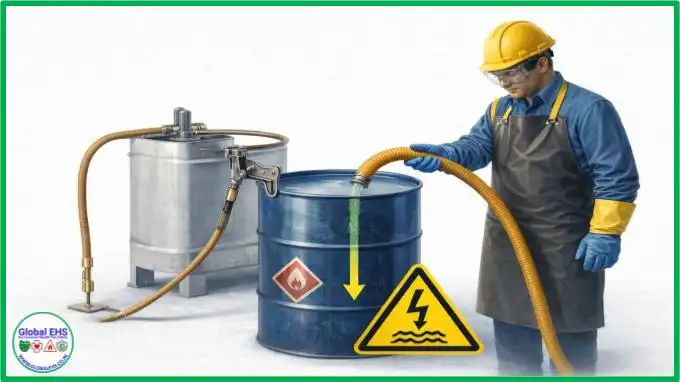
- Ensure proper grounding/bonding of the container before filling to take care of static electricity hazard.
- To avoid splash filling either hose should touch the wall of the container or extended to the bottom.
- No hot work to be carried out on any drum containing flammable mixture without fire and safety permit.
- At the same time, minimum and steady flow rate to be maintained to take care of static generation.
- Filled containers should be properly closed to avoid any spillage/leak.
- Drums should be properly labeled with hazard code emergency instructions & other necessary information.
- Any leaky/defective drum should be separated, contents transferred and area wiped off to avoid fire/accident.
- Where applicable, storage license has to be obtained from Department of Explosives and safety provisions mentioned therein, should be strictly adhered to.
- Drums should not be used as scaffolding for persons to stand and work on.
UNLOADING DRUMS:
- First, fit the vent nozzle with ball valve to the drum vent lid.
- Fit the Outlet nozzle with ball valve to the drum main lid.
- Fix the drum to the drum-tilting stand.
- Ensure the vent & outlet nozzle valves are closed.
- Tilt the drums with the stand.
- Connect the Dosing hosepipe to the outlet nozzle.
- Ensure the hose is properly laid without any bend, cracks, and damage.
- Open the vent nozzle of the drum.
- Start the dosing pump after opening the outlet drum nozzle valve.
SAFETY CHECK POINTS FOR LOADING/UNLOADING OF CHEMICAL:
Safety Department:
- Surprise checking/periodical audits.
Filling Supervisor:
- Earthing
- Any leakages
- Wheel stopper
- M C P
- Loudophone
- Extinguisher in tanker
- Personal Protective Equipment.
- No hot job permit issued
- TERM Card
- General housekeeping
- Standby person
- Procedural violation
- Fire hydrants
- Fire extinguisher boxes.
- Purging vent
- Loading of other tankers at the same time.
- Spark arrestors quality
SECURITY:
- Checking of D. O.
- Checking of spark arrestor.
- Checking of match box/lighter etc.
- Checking of Drivers license.
PTD/MOP (Marketing):
- CCE permission
- RTO permission (Registration tax validity)
- Road worthiness certificate
SAFETY BEFORE LOADING CHEMICAL:
- Calling standby Fireman with readiness at site, when required.
- Tanker number matches with number on requisition slip.
- Wooden wedge fixed at wheel.
- Nitrogen line has sufficient pressure for purging before and after loading.
- Feed line has sufficient pressure to fill the tanker.
- Other utilities like steam, instrument air etc. is ready at site.
- During filling, flow measurement and recording, checking of pressure, temperature, level etc.
SAFETY AFTER LOADING CHEMICAL:
- Tanker level/weight check.
- Both hoses purged with Nitrogen
- Tanker pressure, level, temperature checked and within limit.
- Both the valve on tankers are closed, blinded and leak tested.
- Both the hose connections removed.
- Earthing connection removed
- Wooden wedges removed.
- Detected other abnormalities and reported for rectification
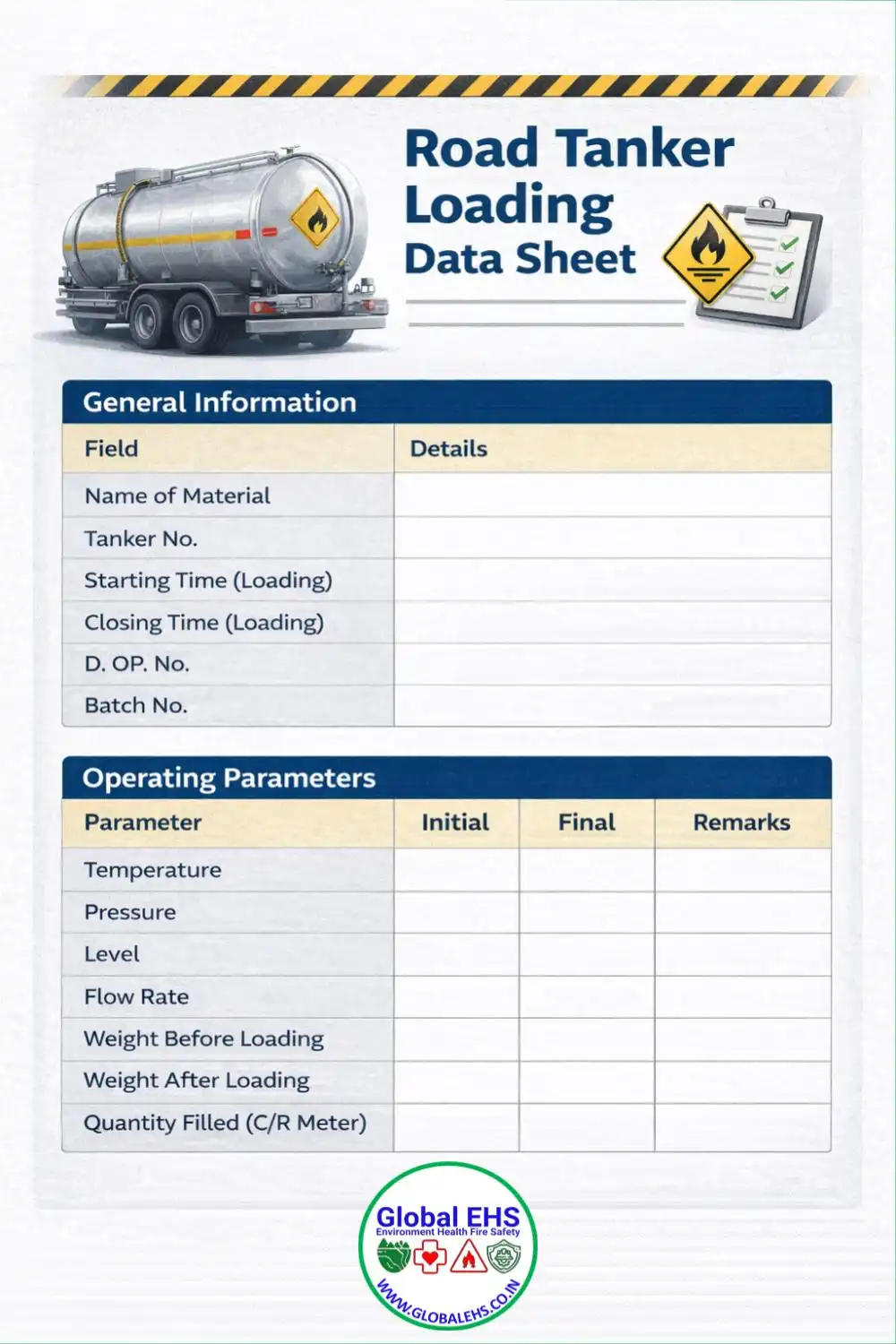
- Data sheet filled.
ROAD TANKER LOADING DATA SHEET.
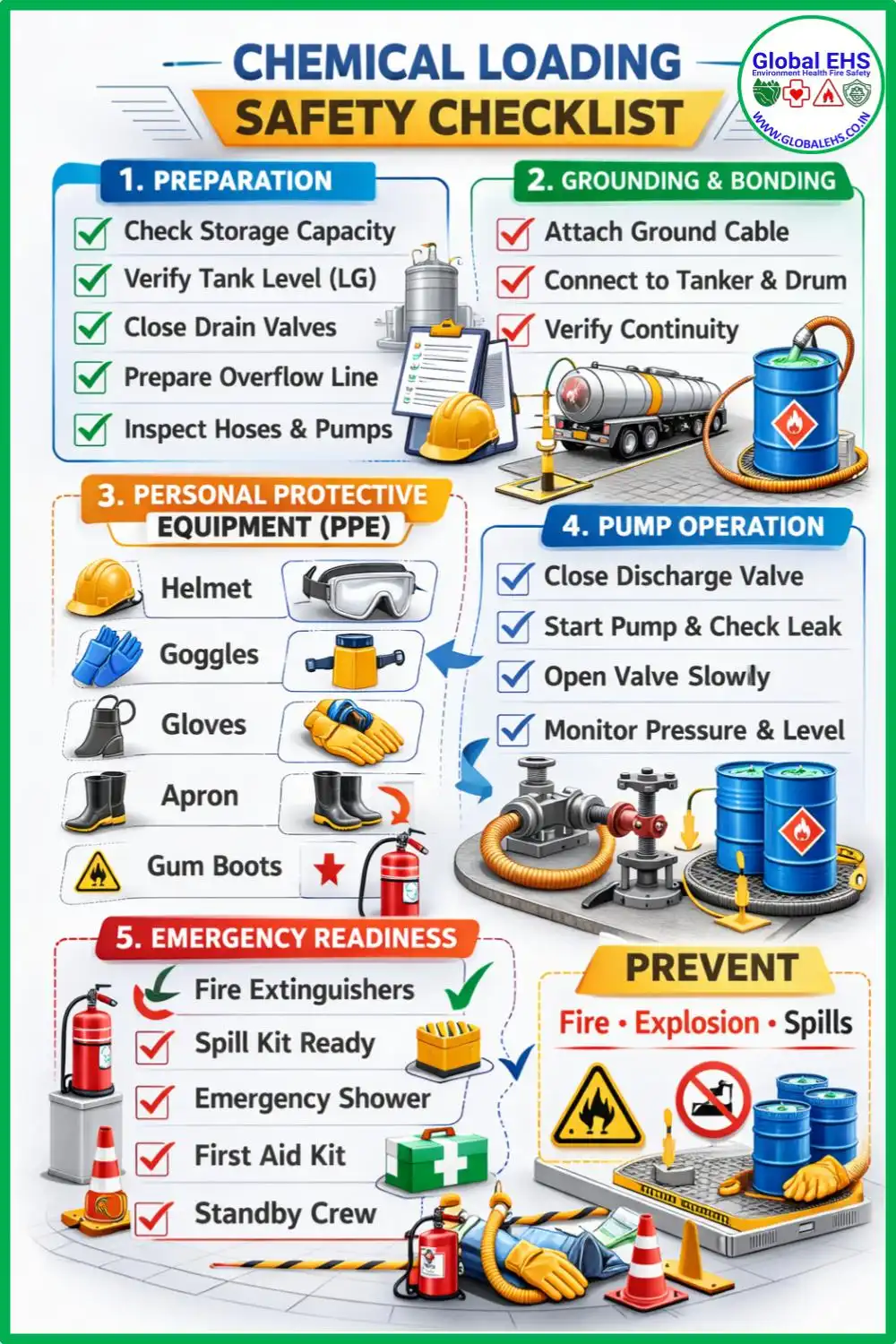
Frequently asked Questions & Answers:
1. What is chemical loading safety?
Chemical loading safety refers to the procedures and precautions taken while transferring chemicals from tankers, drums, or storage vessels to prevent fire, explosions, spills, and exposure hazards.
2. Why is grounding important during tanker unloading?
Grounding prevents static electricity buildup. Static discharge can ignite flammable vapors during chemical loading operations.
3. What PPE is required for chemical loading operations?
Workers must wear safety goggles, face shields, chemical-resistant gloves, aprons, and protective boots depending on the chemical handled.
4. Can you perform hot work near chemical loading areas?
No. strict prohibition of hot work near flammable chemical loading areas unless issuance of a proper fire and safety permit.
5. What are common hazards during chemical tanker unloading?
Common hazards include static electricity ignition, vapor inhalation, overfilling, hose leakage, and improper grounding.